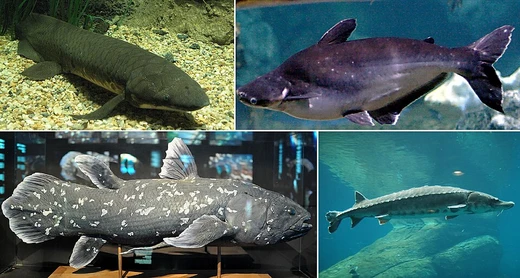
Cusk-eel
Marine fishes resembling eels, found from shallows to hadal depths.

Cusk-eels are a family of marine bony fishes, Ophidiidae, within the order Ophidiiformes. Their scientific name derives from the Greek 'ophis' meaning 'snake', referencing their eel-like appearance, though they are not true eels but part of the Percomorpha clade, which includes tuna, perch, and seahorses. The oldest known fossil cusk-eel is the genus Ampheristus, which existed from the Late Cretaceous (Maastrichtian) to the early Oligocene.
- Scientific name
- Ophidiidae
- Order
- Ophidiiformes
- Number of genera
- 50
- Largest species
- Lamprogrammus shcherbachevi (up to 2 m)
- Oldest fossil genus
- Ampheristus (Late Cretaceous to early Oligocene)
Lore & Background
Cusk-eels inhabit temperate and tropical oceans worldwide, living close to the sea bottom from shallow water to the hadal zone. They are generally solitary, often hiding in muddy bottoms, sinkholes, caves, coral crevices, or among bottom-dwelling invertebrates; some parasitic species live inside hosts such as oysters, clams, and sea cucumbers. They feed nocturnally on invertebrates, crustaceans, and small bottom-dwelling fishes.
Reader's Guide
Cusk-eels are characterized by a long, slender body about 12–13 times as long as it is deep, with dorsal and anal fins typically continuous with the caudal fin, forming a ribbon-like fin. Unlike true eels, they have ventral fins developed into a forked barbel-like organ below the mouth. They are oviparous, with eggs believed to be spawned as free-floating eggs or in mucilaginous rafts; larvae live among plankton near the surface. Classification within Ophidiidae has proven difficult due to inconsistencies in morphological characteristics, and they are currently grouped based on whether they practice viviparity and associated structures. While a few species are fished commercially, such as the pink cusk-eel, insufficient information exists to determine the conservation status of the family as a whole.
Did You Know?
- The oldest fossil cusk-eel is the genus Ampheristus, which existed from the Late Cretaceous to the early Oligocene.
- Cusk-eels have ventral fins developed into a forked barbel-like organ below the mouth, unlike true eels.
- Some cusk-eel species are parasitic, living inside invertebrate hosts such as oysters, clams, and sea cucumbers.
Frequently Asked Questions
Are cusk-eels actually eels?
No, despite their long, serpentine bodies and the Greek root 'ophis' (snake) embedded in their scientific name, cusk-eels are not true eels. They sit within the Percomorpha clade, a group that also includes tuna, perch, and seahorses.
What is the largest cusk-eel species?
The biggest known member of the family is Lamprogrammus shcherbachevi, which can reach a length of up to 2 meters. That is a remarkable size for a group otherwise characterized by slender, eel-like silhouettes.
How old is the cusk-eel lineage?
The oldest known fossil cusk-eel belongs to the genus Ampheristus, which dates from the Late Cretaceous (Maastrichtian) through the early Oligocene. This pushes the family's fossil record back to roughly 70 million years ago.
More in Bony Fish 1-22
Spotted an error? Know more?
This is a living reference — every entry is fact-audited, and reader corrections feed straight into our audit queue. Suggest an edit · See this site's audit record