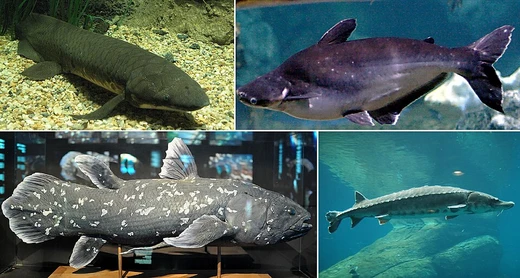
Beluga (sturgeon)
A critically endangered sturgeon prized for its caviar.

The beluga (Huso huso), also known as the beluga sturgeon or great sturgeon, is a species of sturgeon, anadromous fish of the family Acipenseridae. It is found primarily in the Caspian and Black Sea basins, and formerly in the Adriatic Sea. Based on maximum size, it is one of the largest living species of bony fish, though ranking is imprecise due to heavier marine species like the ocean sunfish. Heavily fished for the female's valuable roe, known as beluga caviar, wild populations have been greatly reduced by overfishing and poaching, leading the IUCN to classify the species as critically endangered.
- maximum_recorded_length
- 5–6 m (16–20 ft) widely accepted; unverified reports up to 7.2 m
Lore & Background
The beluga sturgeon shows typical characteristics of other sturgeon, such as an elongated body, heterocercal tail, partially cartilaginous skeleton, naked skin, and longitudinal series of scutes. Juveniles are slender with a narrow head and pointed snout, while adults are heavy-set, spindle-shaped, and humpbacked, with a massive head and large protractile mouth. Very old specimens are stocky with an enormous mouth. The common name derives from the Russian word 'belyj', meaning 'white', referring to the pale colour on flanks and belly. Beluga sturgeon are euryhaline, capable of moving freely between freshwater and estuaries. They are anadromous, migrating upstream in rivers to spawn on clean, hard substrate. Males attain sexual maturity at 12–16 years, females at 16–22 years, and they spawn every four to seven years. Historically, they could migrate up to 1,000 km upriver, but dams have impeded historic spawning routes. As pelagic predators, adults mainly eat large fish (73% of diet), along with molluscs, crustaceans, aquatic birds, and young Caspian seals. Juveniles feed on benthic invertebrates before becoming largely piscivorous at 8–10 cm length.
Reader's Guide
The beluga sturgeon holds significance as the largest freshwater fish in the world and the third-most-massive living bony fish, rivaling the ocean sunfish and great white shark in size. Its legacy is deeply tied to its roe, beluga caviar, considered a delicacy worldwide. However, heavy fishing for caviar, combined with poaching and habitat fragmentation from dams, has driven wild populations to critically endangered status. The species' anadromous life cycle and long maturation period make it especially vulnerable to overexploitation. Conservation efforts are hampered by the rarity of known spawning and nursery sites, particularly in the lower Danube River. The beluga's ability to survive in altered and polluted rivers offers some hope, but its historic range—once spanning the Caspian, Black, and Adriatic Seas—has been greatly reduced. The species remains a symbol of both the grandeur of ancient fish lineages and the consequences of unsustainable human demand.
Did You Know?
- The beluga sturgeon is one of the largest freshwater fish, but its status as the largest is disputed because it is anadromous (spending part of its life in saltwater) and other species like the Mekong giant catfish are a
- The common name 'beluga' comes from the Russian word 'belyj', meaning 'white', referring to its pale flanks and belly.
- Adults are pelagic predators; their diet includes large fish, molluscs, crustaceans, aquatic birds, and young Caspian seals.
Anatomy and the Arc of Growth
The beluga sturgeon carries the classic sturgeon silhouette: an elongated body, a heterocercal tail, a partially cartilaginous skeleton, and bare skin armored by rows of bony scutes. Its dorsal fin bears 48 to 81 soft rays; the shorter anal fin holds 22 to 41. Five longitudinal scute series trace the body, and fine denticles texture the skin. The conical snout is studded with sensory pits on both surfaces, and the broad, crescent-shaped mouth is protractile, its lower lip split by a wide gap. Two pairs of laterally compressed barbels, tipped with leaf-like appendages, sit closer to the mouth than to the snout tip. What makes the species especially striking is how radically it reshapes itself with age. A juvenile is slim and narrow-headed, with a ventrally placed mouth angling upward, a needle-thin snout occupying nearly half the head, and a dark grey or black back over a white belly. By adulthood the body becomes heavy, spindle-shaped, and humpbacked; the head swells, the mouth shifts toward a near-frontal position, the snout shortens to a quarter of the head, and scutes are progressively absorbed. The palette shifts to blue-grey or dark brown above with silver flanks. The oldest individuals grow stocky, with an enormous head and a mouth of staggering width.
Colossal Dimensions and Record Specimens
Among all living bony fishes, the beluga sturgeon ranks as the third-most-massive species, rivaling the ocean sunfish for sheer bulk and trailing only the giant oarfish in length. It holds the title of the world's largest freshwater fish and competes with the great white and Greenland sharks for the distinction of being the largest actively predatory fish. Claims of individuals exceeding 10 meters in length or 3,000 kilograms in weight remain unconfirmed, though not impossible. Among sturgeons, only the closely related Kaluga approaches comparable size, topping out around 1,000 kilograms. These extraordinary sizes belong to very old fish, as belugas continue growing throughout their lives. However, such giants have become increasingly rare under decades of heavy fishing pressure. Females are generally about 20 percent larger than males.
Anadromous Migration and Spawning Biology
As an anadromous species, the beluga sturgeon undertakes extraordinary upstream journeys to spawn on clean, hard substrates that provide both support and cover for its sticky, adhesive eggs. In the Danube basin, the species' spawning biology co-evolved with the formation of the river valley, producing remarkably varied survival strategies among early life stages. To manage these vast distances, the sturgeon employs a two-stage migration: entering the river in autumn, overwintering in its waters, and spawning the following spring in reaches offering adequate substrate and flow conditions. Males reach sexual maturity between 12 and 16 years; females between 16 and 22. Spawning occurs every four to seven years. Historically, belugas could migrate up to 1,000 kilometers upriver, but dams on nearly every major tributary have now blocked those routes. Females deposit eggs on gravel at depths of 4 to 40 meters. Newly hatched embryos measure 11 to 14 millimeters, growing to 18 to 20 millimeters within 10 to 14 days as they absorb their yolk sacs. Young sturgeon heading back to the sea can cover up to 60 kilometers in a single day.
A Species Under Siege
The beluga sturgeon's most defining modern story is one of dramatic decline. Heavily targeted for the female's roe, prized worldwide as beluga caviar, wild populations have been severely reduced by overfishing and poaching. The IUCN now classifies the species as critically endangered. The pressure has been so intense that the average lifespan of wild belugas is no longer known; no confirmed specimen has been documented past its 56th year, even though the species is reportedly capable of surviving well over a century in the wild. The decline is compounded by habitat disruption. Dams on nearly every major tributary the sturgeon once used have severed historic spawning routes, and very few wintering or spawning sites in the lower Danube are currently known, with none identified in the river's upper reaches. Nursery grounds that young sturgeon depend on during their journey to the Black Sea remain largely undocumented. The species, once found in the Adriatic Sea as well as the Caspian and Black Sea basins, now survives in a fraction of its former range, and the giants that once defined it are vanishing.
Frequently Asked Questions
Who is Beluga (sturgeon)?
The beluga (Huso huso) is a large anadromous sturgeon in the family Acipenseridae, native to the Caspian and Black Sea basins and historically the Adriatic. It ranks among the biggest bony fish still alive, with confirmed individuals reaching roughly five to six metres in length.
What are Beluga (sturgeon)'s powers/role?
As an anadromous fish it spends its adult years in the sea yet returns to rivers to spawn, acting as a vital link between marine and freshwater food webs. Its sheer size and long lifespan place it near the top of its habitat, while its roe—beluga caviar—has made it one of the most economically targeted fish on the planet.
How does Beluga (sturgeon)'s story end?
Sustained commercial harvesting and illegal poaching for its roe have driven wild numbers down to a small fraction of historical levels. The IUCN currently classifies the species as Critically Endangered, and without stronger conservation measures its story may end in functional extinction within a few decades.
Why is Beluga (sturgeon) important?
Ecologically it functions as a top-level predator and a keystone connector between sea and river ecosystems in the Black and Caspian basins. Its dramatic decline also serves as a barometer for the broader health of those waterways, and its caviar has held cultural and economic significance for centuries.
What is Beluga (sturgeon)'s maximum recorded size?
The widely accepted upper bound for confirmed specimens sits around five to six metres (roughly 16–20 feet). A handful of unverified historical claims push the figure toward 7.2 metres, but no scientifically documented specimen has been measured at that length.
More in Bony Fish 1-22
Spotted an error? Know more?
This is a living reference — every entry is fact-audited, and reader corrections feed straight into our audit queue. Suggest an edit · See this site's audit record