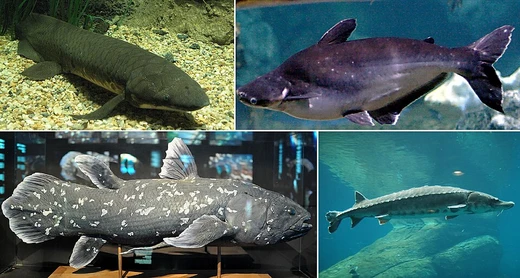
Basa (fish)
A Southeast Asian catfish species important in global food trade.

Basa (Pangasius bocourti) is a species of primarily freshwater-dwelling catfish in the shark-catfish family, Pangasiidae, native to the Mekong and Chao Phraya river basins of Mainland Southeast Asia. Economically important as a regional food source and prized on the international market, it is known under various names including basa, swai, bocourti, river cobbler, and pangasius.
- Diet
- Omnivorous
Lore & Background
The basa has a stout, heavy body with a rounded head broader than it is long and a blunt snout marked by a white band on its muzzle. Ecologically, basa are omnivorous and spawn at the onset of flood season, with young first seen in June, averaging about five centimetres by mid-June. In the marketplace, basa is sold under many names. In the United Kingdom, all species of Pangasius may legally be described as 'river cobbler', 'basa', 'pangasius', or 'panga'; these terms may be used with or without the addition of 'catfish', but 'cobbler' alone is not permitted. In mainland Europe, it is mostly sold as 'pangasius' or 'panga'. In Asian fish markets, names include 'Pacific dory' and 'patin'. Related species such as the iridescent shark and yellowtail catfish are occasionally mislabeled as basa. The species became central to a 'catfish war' in the United States. accused Vietnam of dumping catfish, including P. bocourti, on the American market, arguing that Vietnamese exporters were subsidised and engaged in unfair competition. Congress passed a law preventing the imported fish from being labeled as catfish and imposing additional tariffs. Under the U.S. Food and Drug Administration ruling, only species from the family Ictaluridae can be sold as true catfish. Vietnamese exporters now label their products as basa fish, striped pangasius, swai, or bocourti. At the height of the dispute, U.S. catfish farmers described the imported fish as inferior, but a small blind taste test by Mississippi State University found consumers preferred U.S. catfish over basa.
Reader's Guide
Basa (Pangasius bocourti) holds significance as a major food fish in Southeast Asia and a widely traded commodity in international markets, particularly in Europe, North America, and Australia. Its economic importance is underscored by the legal and trade disputes it has generated, most notably the U.S. 'catfish war' that led to import tariffs and labeling restrictions. The species' adaptability to aquaculture and its role as a cheaper alternative to white fish like cod or haddock have made it a staple in supermarkets, especially in the United Kingdom, where it is sold as 'Vietnamese river cobbler' or 'basa'. However, its farming has raised environmental concerns: organizations such as OceanWise and the Monterey Bay Aquarium have flagged open-cage farming in Southeast Asia for potential pollution, disease transfer to wild basa, and issues with feed quality and wild stock use. Testing by UK supermarkets Asda and Tesco found no toxic contaminants, while Australian testing found trace levels of malachite green, likely from antiparasitic treatment. One case of anaphylaxis in a person without general fish allergy has been reported. The species' legacy includes its role in shaping food labeling laws and debates over sustainable aquaculture.
Did You Know?
- Basa is native to the Mekong and Chao Phraya river basins of Mainland Southeast Asia.
- In the United Kingdom, all species of Pangasius may legally be described as 'river cobbler', 'basa', 'pangasius', or 'panga'; these terms may be used with or without the addition of 'catfish', but 'cobbler' alone is not
- A small blind taste test by Mississippi State University found consumers preferred U.S. catfish over basa.
- One case has been reported of a person without a general fish allergy having an anaphylactic reaction to pangasius.
A Spectrum of Form and Scale
Catfish represent one of the most physically diverse assemblages among ray-finned fish. Within the order Siluriformes, you will find the three largest fish species still alive—the Mekong giant catfish of Southeast Asia, the wels catfish of Eurasia, and the piraíba of South America—alongside the minuscule candiru, a parasitic species that latches onto other fish. What unites this staggering range is the complete absence of traditional scales. Instead, catfish sport either smooth, mucus-coated skin or elaborate bony armor. That armor takes many forms: free dermal plates in loricarioids and the Asian genus Sisor, expanded vertebral processes in Doumeinae and hoplomyzontines, or hypertrophied lateral line ossicles in doradids. Most catfish are negatively buoyant, sinking rather than floating, with heavy bony heads and cylindrical bodies flattened on the underside for benthic life. Their mouths, often expandable and lacking incisiform teeth, are built for suction and gulping rather than biting and cutting prey.
A World Felt, Not Seen
For most catfish, the world is a landscape of taste and touch rather than sight. The maxilla, a bone that in other neopterygian fish helps protrude the mouth for suction feeding, has been repurposed in catfish into a structural base for the maxillary barbels—those whisker-like sensory organs that give the group its name. Depending on the species, catfish may carry anywhere from one to four pairs of these barbels, positioned on the nose, mouth, and chin. Across their bodies, especially along the barbels, larger catfish bear chemoreceptors that let them taste whatever they brush against and detect dissolved chemicals in the water. Gustation is their primary tool for locating food. This reliance on chemical and tactile sensing has allowed many species to shrink their eyes dramatically, and some that colonized underground habitats have lost them entirely, becoming cavefish. Meanwhile, a well-developed Weberian apparatus, paired with a reduced gas bladder, sharpens their hearing and enables sound production.
Spines, Venom, and the Cost of Irritation
Nearly every catfish family carries a formidable defensive weapon: a strong, hollow, bony leading spine on the dorsal and pectoral fins. These spines can lock rigidly outward, inflicting deep wounds on anything that grabs the fish. But the danger goes deeper than a simple puncture. In a remarkable number of species—potentially as many as half of all catfish—those spines can inject a stinging protein when the animal is provoked. This makes Siluriformes the vertebrate order with the greatest number of venomous species, a distinction that underscores just how widespread chemical defense is within the group. The one notable exception is the Malapteruridae, the electric catfish, which have given up the spined defense entirely. For anglers, handlers, and curious children wading in shallow water, the combination of locked spines and venom delivery makes a careless encounter with a large catfish a genuinely painful affair.
From Farm Ponds to Invasive Canals
Catfish occupy a complicated place in human economies and ecosystems. On the productive side, large species like Pangasius (a shark catfish) and Clarias (including the walking catfish) are farmed or wild-caught for food on a commercial scale, feeding millions. Smaller genera such as Corydoras are cornerstones of the freshwater aquarium hobby, prized for their manageable size and active behavior. Yet that same hobby has become a vector for ecological disruption: plecos of the genus Pterygoplichthys, released or escaped from aquariums, have become prolific invasive species in non-native waterways. In the Southern United States, catfish carry a rich patchwork of local slang—"mud cat," "polliwogs," "chuckleheads"—names that shift in meaning from one region to the next, so that "chucklehead" might denote a bullhead in one town and a blue catfish in the next. This linguistic patchwork mirrors the fish's deep cultural entanglement with regional identity.
Frequently Asked Questions
What is Basa (fish)?
Basa is the common name for Pangasius bocourti, a freshwater catfish in the shark-catfish family Pangasiidae that originates from rivers in Mainland Southeast Asia. You will also see it listed under names like swai, bocourti, river cobbler, or simply pangasius.
Where is Basa (fish) native to?
The species calls the Mekong and Chao Phraya river basins home, thriving in the inland waterways of Southeast Asia. It is a primarily freshwater fish, spending its life within those river systems.
What does Basa (fish) eat?
As an omnivore, this catfish consumes both plant material and small aquatic animals found in its river habitat. That broad dietary range helps it grow well in the nutrient-rich waters of its native basins.
Why is Basa (fish) so important in the global food trade?
It has become a staple of international seafood markets because it yields a mild, affordable white fillet in large quantities. Its economic reach stretches from small-scale river fishing in Southeast Asia to mass retail shelves worldwide.
More in Bony Fish 1-22
Spotted an error? Know more?
This is a living reference — every entry is fact-audited, and reader corrections feed straight into our audit queue. Suggest an edit · See this site's audit record