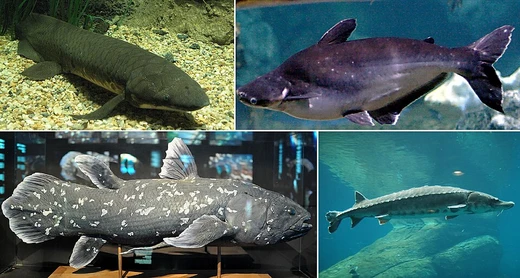
Bowfin
A living fossil fish native to North America.

The bowfin (Amia calva) is a ray-finned fish native to North America, also known by common names such as mudfish, dogfish, and grindle.
- Scientific name
- Amia calva
- Common names
- Mudfish, mud pike, dogfish, grindle, grinnel, swamp trout, choupique
- Native range
- Eastern United States, southern Ontario and Quebec
- Maximum weight
- 9.75 kg (21.5 lb)
- Maximum age
- 33 years
- Closest living relatives
- Gars (Holostei)
Lore & Background
Bowfins are demersal, freshwater piscivores found in vegetated sloughs, lowland rivers, lakes, swamps, and backwater areas, occasionally in brackish water. They are stalking, ambush predators that move into shallows at night to prey on fish and aquatic invertebrates such as crawfish, mollusks, and aquatic insects. Like gars, they are bimodal breathers, using gills for water respiration and a gas bladder connected to the foregut for air breathing, allowing survival in hypoxic conditions. The body is elongated and cylindrical, olive to brown with vertical bars and dark reticulations. Young males have a black eyespot on the caudal peduncle bordered by orange-yellow; females lack or have a black eyespot. The skull consists of 28 fused bones in the dermatocranium, with two sets of teeth: sharp teeth for grasping and pharyngeal tooth patches for grinding. The bowfin retains primitive features including a modified heterocercal tail, a vascularized gas bladder lung, vestiges of a spiral valve, and a bony gular plate under the lower jaw. Bowfin are often mistaken for northern snakeheads and burbot. Unlike snakeheads, bowfin have a black eyespot on the caudal peduncle, a shorter anal fin, a more rounded head, pelvic fins farther from pectoral fins, a gular plate, and scales that do not continue onto the head. Burbots have a flat head, chin barbel, long anal fin, and pelvic fins under the pectoral fins.
Reader's Guide
The bowfin is significant as a living fossil, representing the Halecomorphi lineage that dates to the Early Triassic. Its retention of primitive features—such as a modified heterocercal tail, a vascularized gas bladder lung, a spiral valve vestige, and a bony gular plate—provides insight into the evolution of ray-finned fishes. As one of only two surviving species in its genus, alongside Amia ocellicauda, it offers a rare window into ancient fish anatomy and physiology. Its bimodal breathing ability, using both gills and a gas bladder lung, allows it to inhabit oxygen-poor waters where other fish cannot survive, demonstrating an evolutionary adaptation to challenging environments. The bowfin's jaw structure, with fused maxilla and premaxilla and a rotating articulation, reflects adaptations for active predation, while its ossified vertebral column with prominent neural spines and ribs provides stability and powerful movement. Ecologically, bowfin are apex predators in their freshwater habitats, controlling populations of fish and invertebrates. Their range, once widespread across multiple continents, is now restricted to eastern North America, making them a subject of conservation interest. The bowfin also serves as a cautionary example for species identification, as it is frequently confused with the invasive northern snakehead, highlighting the importance of distinguishing native from non-native species.
Did You Know?
- Bowfin can breathe air using a gas bladder connected to the foregut, allowing survival in hypoxic water.
- Young males have a black eyespot on the tail base bordered by orange-yellow, thought to confuse predators.
- Bowfin are often mistaken for northern snakeheads, but lack scales on the head and have a gular plate under the jaw.
Deep-Time Survivor: A Lineage Spanning 250 Million Years
It is one of only two species still alive in the order Halecomorphi, a group that once thrived across freshwater and marine waters on every continent—North and South America, Europe, Asia, and Africa. Today, that vast global presence has collapsed to a narrow corridor in the Eastern United States and adjacent southern Canada. Alongside its close relative, the eyespot bowfin (Amia ocellicauda), it belongs to the genus Amia, and its nearest living kin are the gars, together forming the clade Holostei. What makes the bowfin truly remarkable is the suite of ancestral traits it has preserved: a rounded heterocercal caudal fin, a highly vascularized gas-bladder lung, vestiges of a spiral valve, and a bony gular plate beneath the jaw. Yet it is not uniformly primitive—its large, single-layered cycloid scales actually resemble those of more modern teleosts rather than the ganoid scales of the oldest actinopterygians, showing that evolution is never a simple march forward.
Anatomy of an Ambush Predator
The bowfin's body is a masterclass in concealment. Its elongated, cylindrical form is painted in olive and brown tones, broken up by vertical bars and dark reticulations that dissolve its outline against muddy, vegetated water. The underside fades to white or cream, while the paired fins and anal fin flash a vivid green. The skull is a two-layered structure of 28 fused dermal bones overlying a hidden chondrocranium, housing two distinct dental systems: large, sharp teeth on the mandible and premaxilla for seizing prey, and posterior pharyngeal tooth patches anchored to the hyomandibular bone for grinding. Young males sport a black eyespot ringed in orange-yellow on the tail base—a decoy that lures predator strikes away from the head and buys the fish a chance to dart free.
Breathing Two Worlds: The Bimodal Respiratory System
Few freshwater fish can do what the bowfin does: survive in water so depleted of oxygen that most species would suffocate within minutes. Like its close relatives the gars, the bowfin is a bimodal breather. Its gills handle gas exchange underwater as expected, but it also possesses a highly vascularized gas bladder that doubles as a functional lung. A small pneumatic duct runs from the foregut directly to this organ, allowing the fish to rise to the surface, gulp air, and replenish its oxygen stores. This dual-system design is one of the primitive traits it has inherited from its Triassic ancestors, and it gives the bowfin a remarkable tolerance for the stagnant, low-oxygen swamps and backwaters it favors. The gas bladder also serves the more conventional role of maintaining buoyancy. Combined with a reported maximum lifespan of 33 years, this respiratory flexibility means a single bowfin can persist in the same sluggish waterway for decades, outlasting seasonal die-offs that wipe out less adaptable neighbors.
Habitat, Hunt, and the Life Cycle
The bowfin is a demersal, freshwater piscivore that calls the vegetated sloughs, lowland rivers, swamps, and backwater pockets of the Eastern United States and southern Ontario and Quebec home. Its range spans the drainage basins of the Mississippi River, the Great Lakes, and rivers draining into the Eastern Seaboard or Gulf of Mexico, with occasional forays into brackish water. Locals have known it by a dozen names—mudfish, mud pike, dogfish, grindle, grinnel, swamp trout, choupique—each reflecting the murky, slow-moving waters where it lurks. As a stalking, ambush predator, the bowfin favors nighttime forays into shallows, where it takes fish, crawfish, mollusks, and aquatic insects. Its young emerge from the nest as tiny black, tadpole-like larvae just 7 to 10 millimeters long; by 25 millimeters they are described as resembling miniature placoderms. They grow rapidly, leaving the nest within four to six weeks and reaching 13 to 23 centimeters by October of their first year.
Frequently Asked Questions
What is a bowfin?
The bowfin (Amia calva) is a ray-finned freshwater fish found in North America. It is one of only two surviving members of the order Halecomorphi, a lineage whose ancestors first appeared during the Early Triassic.
Where do bowfins live?
Their native range stretches across the eastern United States and northward into southern Ontario and Quebec. They favor slow, vegetated, low-oxygen waters such as swamps, backwaters, and muddy river bends.
What other names do people use for the bowfin?
Depending on the region you're in, you'll hear it called mudfish, mud pike, dogfish, grindle, grinnel, swamp trout, or choupique. Most of those local nicknames point to its murky habitat or its elongated, pike-like silhouette.
More in Bony Fish 1-22
Spotted an error? Know more?
This is a living reference — every entry is fact-audited, and reader corrections feed straight into our audit queue. Suggest an edit · See this site's audit record