Frequently Asked Questions
The most-asked questions about bony fish.
What exactly are bony fish?
Bony fish, or Osteichthyes, are vertebrates whose skeletons are built primarily from mineralized bone rather than cartilage. They account for the vast majority of all living fish species, ranging from millimetre-scale killifish to the whale-sized giants of the open ocean.
How many species of bony fish exist?
Roughly 30,000 to 35,000 described species are currently recognized, making them the most species-rich vertebrate group on Earth. New species continue to be described regularly from deep-sea trawls and tropical reef surveys.
What are the two main subgroups of bony fish?
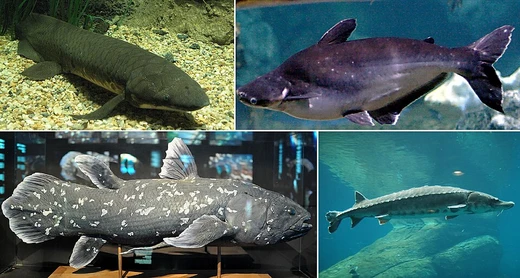
Osteichthyes divides into Actinopterygii (ray-finned fish, which include the overwhelming majority of species) and Sarcopterygii (lobe-finned fish, a smaller but evolutionarily pivotal group that eventually gave rise to tetrapods).
How are bony fish different from sharks and rays?
Sharks and rays belong to Chondrichthyes, whose skeletons are cartilage-based, while bony fish have a true bone skeleton. Bony fish also typically possess an operculum covering the gills and, in most lineages, a gas-filled swim bladder for buoyancy control.
Where can bony fish be found?
They occupy virtually every aquatic habitat on the planet—oceans, freshwater rivers and lakes, brackish estuaries, and even high-altitude mountain streams. A few species, such as mudskippers, can briefly leave the water entirely to forage on land.
What is the largest bony fish?
The ocean sunfish (Mola mola) is widely regarded as the heaviest bony fish, with documented individuals exceeding 2,000 kg. The much longer whale shark is often confused with it, but it is actually a cartilaginous fish, not a member of Osteichthyes.
What is the smallest bony fish?
The dwarf hamhead (Pancratius humeralis) and the glassfish Paedocypris progenetica are both under 8 mm, making them among the tiniest known vertebrates. They inhabit the shallow, slow-moving waters of Southeast Asian rivers.
How did bony fish evolve?
Bony fish diverged from their cartilaginous ancestors roughly 450 million years ago during the Ordovician period. The lobe-finned lineage later produced the first tetrapods, meaning every four-limbed vertebrate traces its ancestry back to a bony fish.
Which species are the 'main characters' fans talk about most?
Go-to examples include the clownfish, the blue tang, the zebrafish (a key model organism), the pufferfish, and the archerfish. Each has a distinctive behaviour or colouration that makes it a staple of popular media, aquarium hobbyism, and introductory biology courses.
Where should a newcomer start learning about bony fish?
A solid first step is grasping the two major subgroups—ray-finned versus lobe-finned—and then exploring a handful of well-known families such as cichlids, salmonids, or characins. Picking a single habitat to focus on, whether a coral reef, a deep-sea trench, or a particular river system, keeps the scope manageable and rewarding.